
Slap! The first kick landed on the outside of my shin as he tried sweeping my leg. Slap! Another attempt at the same move. A minute passed as we circled each other, searching for grips. Slap! Goddammit!, I thought. Slap! Slap! Come on! I grabbed the back of his neck with a collar tie and reached for his elbow. I kicked towards the outside of his shin, attempting to return the favor, and missed wildly. Slap! You bastard. You rotten, no good…
My shin throbbed, and I was completely exhausted. I shot a takedown, hoping to bring the fight to the ground and save me from more kick sweeps. He stuffed the shot and found a guillotine choke instead. This was my first night of training with Algeria Warrior Team, and it wasn’t going as planned. I smiled through the post-training locker room banter, feeling entirely out of place as I forced a grin.
What am I doing here?, I thought as I climbed the stairs to my guesthouse. The idea of training with this team every day for the next two weeks plunged me into a deep pool of self-doubt. I sat on the edge of my bed, licking my wounds. Just show up. Heed the advice you give to all beginners and show up. That’s all you have to do.
My first night went poorly; so be it. But my pilot light quickly found dry tinder, giving way to a burgeoning flame. This experience was about more than first impressions. They view me how they view me, and that’s that, I told myself over and over. My job was to be there and connect with them, and if I pushed hard enough, they’d have to respect my effort. They’d have no choice.
So I showed up and put in the work. I watched every technical detail with tunnel vision. After class each night, I’d replay the techniques ad nauseam in my mind. I focused on sparring with the best in the room as much as possible, regardless of how punishing the rounds felt. Find them, seek them out, bring your best to each round, and learn from them as you go.
There was no doubt that most of the team immediately warmed to me, and any tension I felt was a projection of my mind. But a lone holdout did exist. I knew it, and he knew it. I wanted to right what felt like a listing ship. The man who left the dark purple and brown bruise along the outside of my left shin stood beyond arm’s reach. The one who tested me on the first day and is affectionately known to the team as “Shark.”
Shark wore a poker face through our first few meetings. He perpetually joked with the others, but when he caught my gaze, tension filled the air. He broadcasts a wall-like quality—a man without indecision, a life bound in black and white. And I sensed the only way to the other side of this wall was to go right through it.
I found him on the mat three days later and gestured for him to roll. We slapped hands and began battling. We traded positions, threatened submissions, and both nearly choked each other to a finish. I was on top and reached a dominant position, breathing like I’d just sprinted up a section of Everest. I held on like a bull rider at the rodeo and searched for an opening. When the bell rang, I looked down and saw a new man beneath me. He smiled, reached up to wipe his brow, then hit me with a thunderous backslap. As we stood, he grabbed me and swallowed me up in a brotherly grip. His method of connection was tossing us both into a meat grinder to see how I’d handle myself.
At 42, “Shark” is the eldest of the team’s core members. They gave him the nickname because of his professional military training, and, frankly, because he’s one tough son of a bitch. A team member gave me a rundown of his bio: former special forces, backgrounds in both boxing and Muay Thai, a previous powerlifter, and a trainer for bodyguards, both at home and recently abroad.
“He once stepped out of his car during a traffic stop and punched a cop in the face because the guy was rude,” Ousama told me.
“He punched a cop? Like one of the police at the checkpoints?” I asked.
“Yeah. Punched him right in the face,” he said. “To him, a rude man is a rude man, cop or not. That’s Shark.”
But now, the barrel of the tough guy image was no longer aimed at me, and I moved in for a glimpse of what the other guys saw. My effort brought us close, and from that, he chose to put his weapons down around me. A proud father stepped forward, a perpetual joker, and one of the kindest men I’ve come to know.
At 5’7, with a sharp nose and stout frame, he’s not particularly intimidating. He’s bald, and as a devout Muslim, he has a zebibah (prominent prayer mark) on his forehead from a lifetime of practice. Like me, he’s an athlete in his 40s with fading posture, the last throes of muscular definition, and a lifetime’s worth of aches and pains. But what he lacks in physique and speed, he makes up for in experience, considerable farmer’s strength, and herculean fortitude.
Our conversations were a sloppy mashup of gestures, incomprehensible attempts to speak in varied languages, and straight confusion. He knows less than 10 useful words in English, with “shark” being his most common, and exclusively speaks French and Arabic. Of course, I’m hopeless beyond pleasantries in both, so we spent a ton of time staring at each other, trying desperately to figure out what the other was saying. Our clearest conversation was an exchange in Spanish where we rattled off curse words and phrases unfit for print, but clear in their suggestive nature. We laughed together like a couple of 11-year-old boys, the same way I did when I first learned them on the bus in grade school 30 years earlier.
There were many times he’d turn to me and launch into some monologue in French for two to three paragraphs, gesturing wildly with his hands and then awaiting my reply.
“Shark! I don’t understand,” I laughed. “Je ne parle pas français (I don’t speak French),” to which he’d pause, throw his hands up, and launch right back into another one in Arabic.
“What are you two talking about?” Ousama asked me one evening.
“Dude, I don’t know! Shark looks at me and launches into a tirade. He knows I don’t speak either language, but he keeps going. I just sort of nod my head and try to follow along,” I said.
“He wants to speak English but is nervous to try. He wants to talk to you, so he just starts speaking. Also, Shark is crazy, so I’m not surprised,” he laughed.
“Shark, shark, shark,” he’d playfully taunt me, even as I moved through his guard and sat on his chest, attacking his neck. “Shark,” I heard him say in a gurgled tone below me, as if trying to talk while being waterboarded. I’m crushing him, leaning into his actual throat with my body weight, and he’s still taunting me? A gladiator. He was born for battle.
“I’m coming for you, Shark!” I said as we scrambled back and forth, trying to one-up each other.
“Time! Stop!” the coach finally said, grinding us to a halt.
“You two fought for over 10 minutes,” Ousama said. “We just let you keep fighting.”
“Why?” I asked.
“It looked fun. You were killing each other and laughing at the same time,” he said.
We stood up and grabbed each other’s shoulders, leaning forehead to forehead and heaving from the effort. “My man,” I said, pulling the mouthguard from my lips.
“Shark…….Shark,” he said as we walked off the mat, gesturing with his hands in a large biting motion.
Most nights, he drove me to the gym with the coach and took me out for dinner after training. If I sat facing the door to eat, Shark would force me to switch seats so he could watch who came in and out of the restaurant.
“Security,” said the professor one evening as Shark and I shuffled seats. “He’s like your bodyguard in Algeria now. Anything you need.”
“I thought it was really safe. Is this neighborhood dangerous?” I asked.
“No, not dangerous. But Shark wants to make sure there are no problems for you,” he shared.
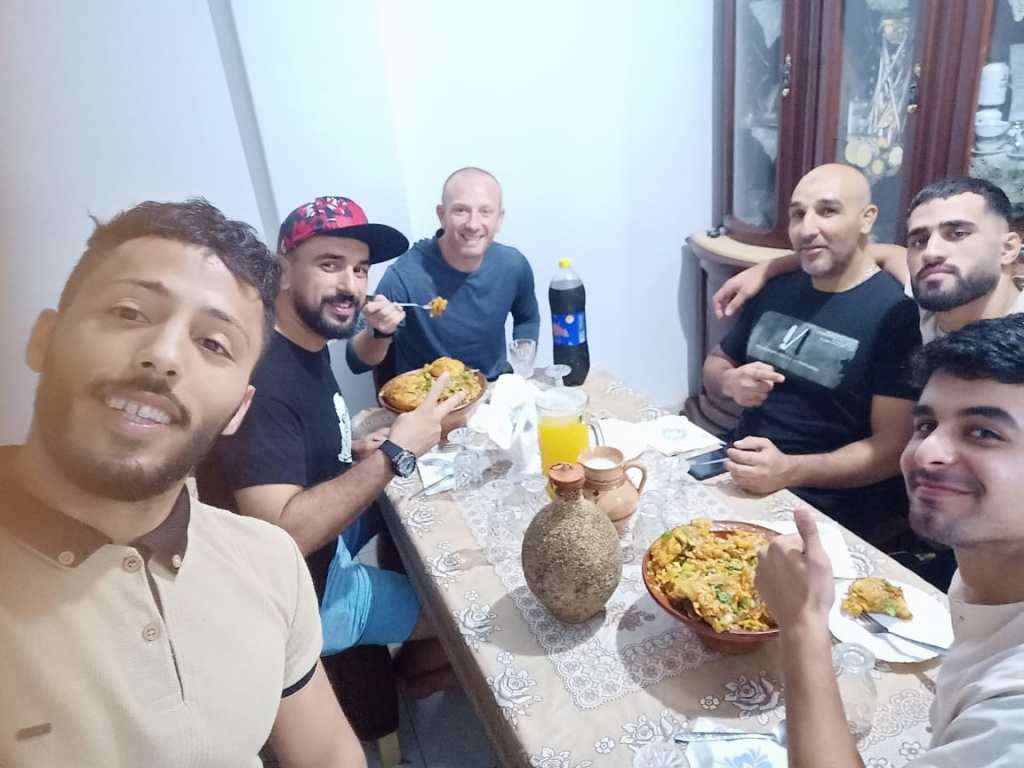
When we ate together, the team would pile mounds of food in front of me as if it were an eating contest. Shark would rearrange the plates to ensure the meatiest chunks of food were mine. If I tried to push back, they’d heap more food in front of me as a friendly punishment for my insolence. We ate with our hands from communal bowls, stuffing our maws and endlessly joking. We talked with our mouths full and licked our greasy fingers as we passed bread and harissa back and forth. There were no formalities; there was no wiping your mouth between bites. It felt natural to eat this way as a group, the same way I ate by myself after training at home. If the younger guys were eating too fast and gobbling up large portions, Shark would snatch the food from their hands and berate them as he placed their chunks of meat in front of me. Food would nearly fall from our mouths with laughter as we listened to Shark call them names. They, too, would double over in laughter at hearing his accusations.
“Shark just called me a camel and said I eat like a dog in the same sentence!” one said. The table erupted in laughter. I peeked around the restaurant and noticed a nearby table full of smiling men looking at us. Apparently, Shark’s thoughts brought them humor too. Food was communal here—a real point of connection. Sharing always came first, and mixed well a good dose of laughter.
They’d pay for my meals and take me for tea afterwards, often walking through local neighborhoods in Algiers I’d never find on my own. They became the keys to my experience, the doorway to my understanding, and the vehicle for my cultural exploration.
One night after training, Shark unknowingly prompted a categorical shift in my affection for him. He gestured towards my phone and asked for the Google Translate app. I switched the function, French to English, and handed him the phone. He tapped the microphone button as we walked.
“When you return to Algeria in the future, you contact me first. I will arrange everything for you, and you will be my guest. No guesthouse, no hotel. I will handle it for you,” it read. I looked at him and said “sahha” (thank you in regional Arabic), bringing my right hand to my heart. His eyes looked forward, never deviating from our path. He threw up his hand in what would usually be a dismissive gesture. “Hoya,” he said (brother), and he walked ahead.
My last sparring rounds in Algeria were with Shark. We trained hard to a stalemate, hand fighting, cranking on each other’s necks, and taking failed shots. Shark left a right hand’s worth of scratch marks across the back of my neck from a missed collar tie. When our round ended, I grabbed him and slapped his back. I felt deep appreciation for one more battle together.
We all showered, and while in the car on the way to the restaurant, Shark told the professor that my jiu-jitsu had improved dramatically in the two weeks of training together.
“Shark says you’re a warrior. He’s proud to know you,” he said.
I sat in the back, fighting the urge of a middle-aged western man to tear up and respond with some long-winded prose on the importance of cultural interaction and blah, blah, blah.
“Keef keef, hoya (same, brother),” I said in Algerian Arabic. I watched his head nod in a gesture of stoic approval.
We arrived at the restaurant, where they ordered two hefty rotisserie chickens cut into quarters. A mound of several baguettes sliced into fist-length pieces sat piled high in a woven basket. When the platter arrived, Shark reached out and turned the huge tray so the prize piece sat in front of me. The plate was filled with fat drippings, and a flavorful sauce pooled below the chicken. We sopped up the mixture with chunks of bread, sending it flying like liquid shrapnel around the table. When the chicken cooled, we ripped at the meat, stuffing, chewing, and laughing as we ate. My hunger was insatiable, not only for the food but for the camaraderie. The experience was almost too good to be true, and now it was ending. We licked our fingers as we laughed, chewing up everything we could swallow. I gnawed at the last bits of meat on a breastbone, not wanting to waste a piece. Shark noticed me digging at the meat with my teeth and reached across the table, pulling the chicken bones right out of my mouth. He reached up to his own mouth, pulled the meaty, half-eaten drumstick from his lips, and shoved it in my hand. He went back to gnawing on the breastbone the way I had been a moment before. Did he just take the food from his own mouth and give it to me? I looked around to see if this was a joke.
“Eat! Eat!” one team member said.
“He just gave me food from his mouth,” I said.
“You’re his brother now. He gives you what you need. Now eat!” he said.
So I ate, and I watched Shark extract the last pieces of chicken from my chewed up old bones. There was no pride on his face or pomp in his gesture. His eyes were focused on the chicken, and then he shifted right back to making jokes. You need to eat, and I have food in my mouth? Here, take it.
I felt overwhelmed with emotion. I smiled and laughed to keep the momentum where it was, but I spent a few seconds of the moment absent from reality. I wanted to be present and not miss a second of what we’d accomplished together during my stay. But my mind was processing a new form of kindness. A kindness that felt primal and dependent. The kind a parent likely feels for a child; the kind I’ve felt from my parents but never from a two-week-old friend. I felt the many broken fences in my past being mended all at once by the toughest guy in the room—fences I had smashed over time with anger, jealousy, imprudence, and ignorance. I saw my selfishness so completely. Life’s wasteland of bad decisions lodged deep in my memory felt entirely approachable. It felt like I’d been given true kindness as a tool, with a roadmap on how to remedy the wrongs I’d caused the world. In Shark’s mind, he simply saw my hunger and fixed it at his marginal expense. A small gesture from him that landed like a sledgehammer for me.
After dinner, I said goodbye to the team. I felt a tangle of sadness and joy when it came to Shark. We grabbed each other’s shoulders and slapped chests. I’d gained so much in one simple moment with him and was hopeful that during our brief time together, he would gain something useful in return. I’m unsure if he did. At minimum, though, he inherited a student—one eager to learn this form of effortless kindness and deadset on bringing others the joy that his brief, but meaningful friendship brought to me.


 Stirring Point
Leave a reply to daniellerake Cancel reply