I let the offer sink in: a personal guide through the Swat Valley who happened to be from the region? You bet your ass. Of course, I’d have to wait a few years until I returned to Pakistan, but that’ll come soon enough.
Like freshmen in a college dorm, we traded bands and watched music videos on his laptop. Like sophomores, we talked politics and bilateral agreements between Washington, D.C. and Islamabad. Like juniors, we discussed the country’s mounting instability. How much more could Pakistan borrow from the IMF? And like seniors, we called it all a racket. The imprisonment of Imran Khan, Pakistan’s deposed Prime Minister, felt like a stake driven into the heart of the nation. How did he feel about Kahn and the hundreds of charges brought against him? Like everyone I’d spoken to: Pissed off. “Khan was a scapegoat,” they told me. The Army generals and the country’s powerful elite (the Sharifs and the Bhuttos) were punishing him for speaking out against the West’s “not so hidden” imperialism. These families, frequently tainted by corruption, had spent decades vying for dominance and had grown accustomed to the investments made during the era of Pax Americana. But the tides of shifting international power have led to nations realigning themselves for better trade deals, security and resources. Khan was stirring up establishment corruption by refusing to fall in line with the entrenched interests of the country’s leadership. Much of Pakistan’s elite cozied up to America and her dollars. Khan, not so subtly, spit in her face.
Following the tangled knot of Pakistani politics was challenging enough while sober. The hash upended the thin roots of coherence I’d managed to plant since my arrival. “Understand, man. We’ve had 75 years of separation from India and 75 years of independence. Politics are fucked here. In 75 years, we’ve never had a prime minister finish a full term. People are getting out of this place left and right.”
We wrapped up the visit with my promise to return and his promise to guide me. “Don’t say it if you don’t mean it,” I told him. “I’ll come back and I’ll call on you.”
“You’ll be my guest,” he said, walking us to the door. The hash was mellowing, but it left a cloud around the edges of my vision. I looked down at my desert boots, dusty and worn, wondering what they’d say if they could talk. I was always moving: across the oil-soaked sand of Karachi’s shoreline, atop the baking pavement of the Sahara in August, trudging through the rain-soaked alleys of Addis Ababa. The suede of the boots had taken on a worn patina reserved mostly for carbon steel. “Dear Lord,” they’d gasp. “Let us breathe.” For a moment, a pang of sympathy ran through me.
The planks creaked as we descended the steps, while exposed wiring threatened to zap us. The stench of the alleyway hit me near the bottom step and jabbed my nose. Raw sewage flowed through open drains. Drums of cloudy cooking oil lined the walkway, open at the top like plunge pools for curious insects. 3 men slept on the sidewalk, indifferent to the heat, the roaches and the sludge. Piles of trash were stacked shoulder-high. My sober mind had waltzed right past this on the way in, lost in the promise of new friends with fresh perspectives. But the hash had heightened my senses. The darkness swallowed up the last bit of light. Poverty and pollution. Holy hell.
We used the Bolt app to call a taxi and climbed in half stoned when it arrived. I plopped in the front while my friend from Islamabad climbed in the back. He barely rattled off a few pleasantries in Urdu before the driver stomped on the gas pedal and thrust us into traffic. I reached for the handle above the door and nearly yanked it from the ceiling. This son of a bitch is crazy. Who drives like this?
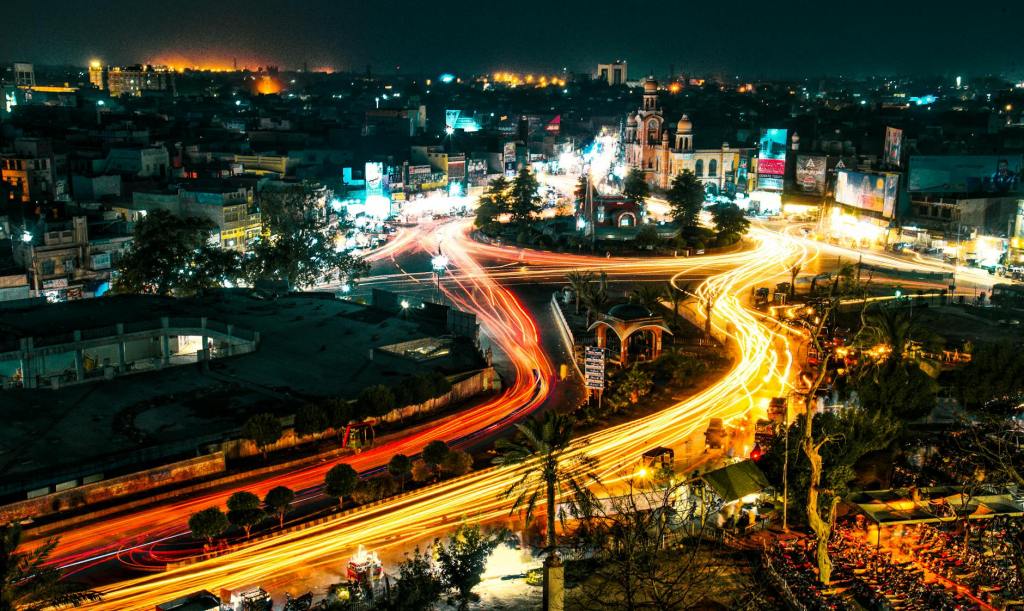
The driver merged without looking, slammed on the brakes and passed along the shoulder. We nearly killed a motorcyclist and came within inches of crashing into a bridge pylon. Like a frightened child, I closed my eyes, exhaled and wanted to scream. This is where I die, on a street in Karachi, in a tangled ball of steel and fire. For a moment, I thought it might be wise to pull over, toss some money into the bastard’s lap, and take my chance with the city’s stickup kids.
A few breaths later, I opened my eyes to the taillights of a packed intersection. Traffic Jam. Hallelujah! I’d never been happier to limp along at a slug’s pace, swallowed up in the city’s congestion, hopeful there’d be no space for it to hock us out. The driver craned his neck and searched for an opening. His torso squirmed like he was trying to free himself from quicksand.
When we got to the apartment, I slipped off my shoes, brushed my teeth and gulped water from a jug. I climbed into bed and stared at the blank white screen of the ceiling above. A movie filled with oil drums, sleeping men and raw sewage ran through my mind in some half-suspended reality. I’d become a master of compartmentalizing the world’s poverty. I saw it when I had to, then stuffed it in its corner when I was done with it. Karachi, though, had no corners left—nowhere to stuff its poverty. Everything is everywhere, all the time.


 Stirring Point
Leave a comment