
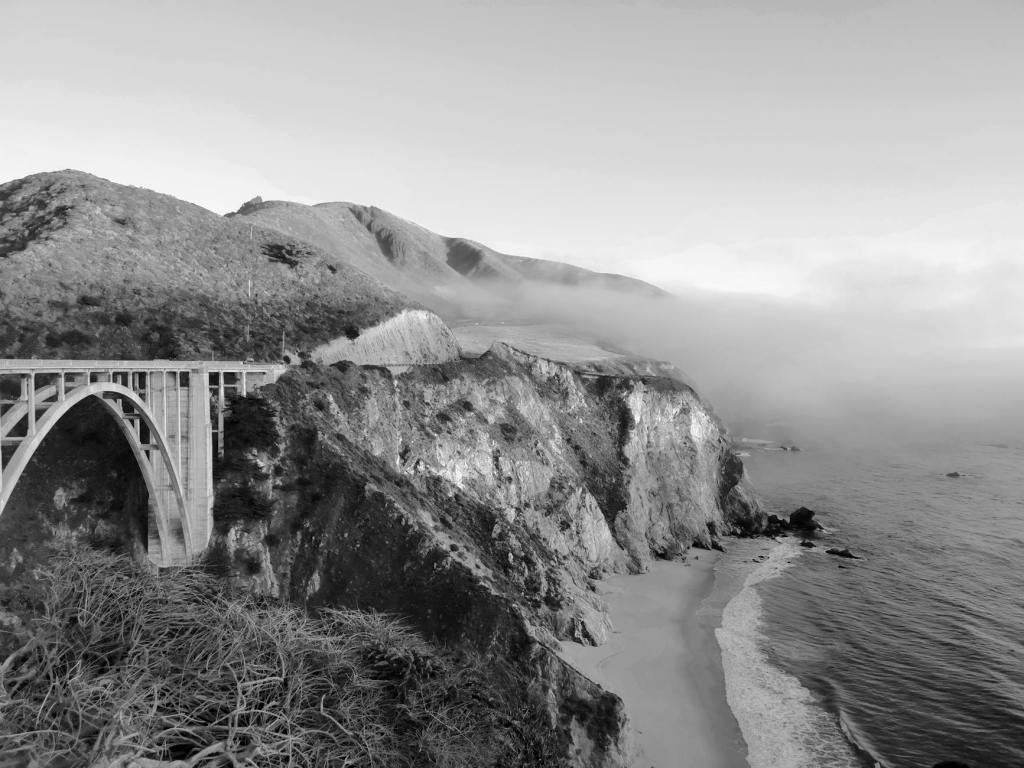
The long stretch of highway hugs the red-rocked cliffside. The land plummets dramatically like a lone lemming into the sea. It’s grand; it’s overwhelming. My tongue forgets its purpose and my words return to the cloistered halls of the mind. The view requires capitulation and I’m here once more to submit. It’s been 18 years since my last visit and it captures me just the same. I sit back and accept the experience, awash in the sublime, and hope the road never ends. This must be the gateway to heaven; its raw power almost makes one a believer. I’m a child in its presence. I’m a child in Big Sur.
Big Sur was my first pilgrimage. After the death of a friend’s father in 2006, I kicked the mud off my boots and headed west. I was 24 years old, rich with self-doubt and had just enough coin in my pocket for a 3-week cross-country trip. So I packed the car, grabbed a road atlas and hit the highway. The summer air told the story of sticky nights, cold beer, and backyard grilling. I wanted none of it. Like a shark in water, I needed to move. A few years prior, travel hit me like a tsunami and swept my former self out to sea. I yearned for the road like a dope fiend to a needle. The outcome of my life? My career prospects? They were tiresome chores if they failed to include travel.
My highlighter mapped a long stretch of Route 80 on the atlas, running headlong through the prairie and grasslands of the Midwest. Directional decisions came around Cheyenne, Wyoming, when I cut a line northwest toward the open belly of Montana. The world came alive under the expanse of the Montana sky. The openness at dusk pulled me to the roadside and pinned my eyes to its ceiling. I leaned against the car, pulling drags from my cigarette, and stared into a spectrum of purple and orange. It spilled its way across the atmospheric canvas and for a moment, made me whole. Clouds morphed from shapes to figures, while the horizon hid behind the endless expanse of space.
From Montana, I slipped into Idaho via Lolo Pass. The road slithered through rising valleys and pinched corridors as it scaled the mountainside. Ponderosa pines thickened the landscape and cast shade along the road’s berm. The Lochsa River gurgled and pooled around smooth stones and fallen logs. This was my country? This was America? I gulped its beauty, spoonful by spoonful.
I soon crossed the border into eastern Washington and hammered the gas pedal for hours on end. The shrub steppe raced by at record speed while the sun baked the black paint on the car’s surface. My mind saw only the coastline and left me desperate for a whiff of Pacific air. Seattle gave way to Portland. Portland gave way to the coast. Catching U.S. Route 101 felt like I’d crested a personal peak. My back seemed to relax. My heart rate dropped. I was coasting.
The 101 poured me south through Coos Bay, Port Oxford, and Gold Beach. It shot me out into the Redwoods of Northern California, through Eureka, and pulled me inland near the King Range. At Leggett, I caught my first glimpse of California Highway 1 and put my atlas in the glovebox. I’d made it.
From Point Reyes to San Francisco, and from Santa Cruz to Carmel-by-the-Sea, I thought about a life here. Was growing up out west so foreign to the eastern woods of Pennsylvania, where I splashed in lakes and climbed trees as a child? If I picked up my whole world—family, friends, teachers—and swapped only the landscape, how different would I be? The ocean, the coastline—they’d change me, but how much? Would I bear any resemblance to this version of “me,” or would nature peel back a layer and bake my whole cake differently?
Reaching the Carmel Highlands signalled the last leg of my pilgrimage. Big Sur had beckoned me from the east, and like a mother calling to her child, I followed its voice 3000 miles to this point. Every bend in the road felt like I was seeing through the eyes of a newborn. Every crashing wave felt like it baptised my view. Harbor seals gathered on rocky outcrops like coeds on the beach. Whales spouted salt water from their blowholes in roaming pairs.
I turned off the music and took in the sounds of the ocean. This world in front of me—a heaven of natural wonder—was the same world filled with landfills, oil spills, and microplastics. It was the same world filled with gun violence, racism, and hatred. I pulled over and stepped out of the car near a cliff’s edge. Cobalt and turquoise swam together, then shifted to white as they smashed against the rocks. It felt timeless—much bigger than the temporal concerns of humanity.
An hour later, I reached the aging walls of the Henry Miller Memorial Library—the one “church” my 24-year-old self felt deserved prostration. Miller was one of the great 20th-century writers but found little acclaim in the U.S. during his lifetime, due to the salacious content of his pages. For decades, most of his early works were banned in America but found wide readership in Europe among bohemian crowds. American puritans had robbed the nation of masterful writing, only to practice their own brand of filth and decadence behind closed doors. These people were illiberal hypocrites with a penchant for control—some things will never change.
I stayed for a while, bought a few books, and talked to the shopkeeper. He showed me some artifacts, let me peek behind a few closed doors and wished me well before I left. I drove a few more miles, then found an ideal pull-off down the road. As I leaned against the hood of my car, I thought about all the possible directions in life and how most of them were beyond my reach. Would I one day make a living from travel? Would this always be a hobby, or could it be more? Untangling the knots of meaning felt daunting, but I was starting to tug on the right string. Meaning was mine to make and travel brought me immense meaning. It brought me here, to Big Sur, to nature’s gospel, where I heard the truth in its words. Travel would one day show me something holy, something worthy of veneration. It would unlock a view of my existence, its precious nature, and its utter meaninglessness. It would show me this paradox and help me see the comedy in the stitching. It’d help me fling my hallelujahs and amens to the present moment and nowhere else. And that’d be enough. To know that heaven is right here, and it’s right now. It’s in Big Sur. It’s in every waking breath.
As Henry Miller once said of this very place, “It was here in Big Sur that I first learned to say Amen.”


 Stirring Point
Leave a comment